Sunday, January 1, 2017

Marathon splits vs. Radial velocity signal of an exoplanet

This is sort of a mini-post to follow up my Clarence DeMar marathon post. I saved each of my mile splits from my race on my watch and decided that I wanted to present them in x-y axis form:
Yes, I stopped after 5K into the race to use a porta-potty and yes, there was a 
man standing in front of his home blasting Star Wars music during mile 14.

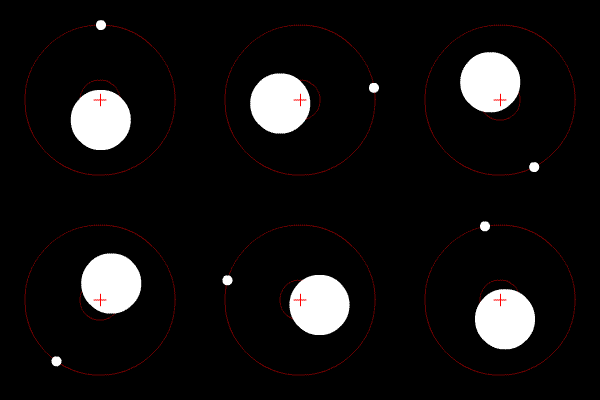
Take away point: I started the race too fast and my average pace is comparable to the radial velocity signal of a Neptune-sized planet orbiting 4 times closer to the Sun than Mercury does. The radial velocity signal is a measurement of the pull of the planet (due to gravity) on the star. It looks like this


When you put things in terms of giant planets, 4 meters per second seems more impressive.

:^)

Saturday, December 31, 2016

The 2016 Clarence DeMar Marathon

I ran a marathon in September. It was the Clarence DeMar marathon in New Hampshire and it started at 8:00am in some town I had never heard of with the temperature at 4C (that means cold for my fellow Americans of the Fahrenheit persuasion). I had been training for this race for about 12 weeks and I felt pretty good about meeting my goal of qualifying for the Boston marathon, which meant finishing 26.2 miles in under 3 hours 5 minutes. I feel like the training is something that is overlooked or just under appreciated sometimes despite that being at least 50% of the total effort that goes into the marathon.

I ended up finishing the marathon in 2 hours 56 minutes 22 seconds:


This was also a 23 minute improvement and personal best from my first marathon in November 2015. I think the biggest difference between these two races was the extra 4 weeks of training I had for my second marathon over the first one. Endurance running in general is about consistency and for the marathon, that means training consistently for many weeks before a race. I had a solid daily training schedule for both of my marathons, but I was unable to give myself enough time over a long term period to prepare for it. This was made very obvious to me in the last 3 miles of both races.

In my first marathon, I hit the "wall" at mile 23 and it took me another 30-40 minutes to finish the race. I was fully aware of my surroundings and knew more or less what was happening, but I couldn't even will myself into running until the very last few minutes of the race. This is in contrast to my second marathon where I started feeling particularly fatigued around mile 23 or 24, but I was nowhere near the same broken-down state as I was in my first race.

Of course, the second race benefited from the experience of the first as well as a few other motivating factors I haven't mentioned yet like Clark the cat and some trophies from a 5K back in May 2016:


Clark lives with another graduate student in the astronomy department. We stayed at his house (the grad student's, but I suppose it was Clark's house too) the night before the Clarence DeMar marathon and Clark was kind enough to keep us all company.


Just before I formally started training for my second marathon, I did a sort of "rust buster" 5K. I was part-way treating it as a work out, but I ended up crossing the finish line before anyone else and receiving these two trophies.

This is a picture of me running back home with them.

This is also why I prefer medals. Those trophies were heavy.


So between the 5K at very start of my training up until the night before the race, I found a few small things to keep me motivated. Hopefully being on the front page of the Clarence DeMar marathon webpage will serve as some more motivation for all the training and races I do in the future.


:^)

The Clay Telescope

Back in spring this year I started volunteering for the Harvard Observing Project (HOP). Each semester, HOP chooses a target to observe with the Clay Telescope in order to publish new data as part of a scientific article. The data are* analyzed by graduate or undergraduate students at the end of the semester and there are usually 7-10 HOP volunteers to help collect the data.
*a physics professor once told me that "data" is a plural term.

Another great part of HOP is that we have our sessions open to other students at Harvard and any guests they want to bring. This means we'll look at 3-5 different celestial objects over a night, including the special science targets. Here is a picture of the Clay Telescope in its dome:


I know it appears like we were just pointing the telescope at some clouds. We were. The hope was that the clouds would pass so that we could observe our science target for the fall semester: KIC 8462852. That's not a toll-free phone number, but a naming scheme devised for the Kepler Space Telescope. KIC is an acronym for the Kepler Input Catalog and the number following it distinguishes between stars put into the catalog. This star became more popular than your typical KIC object when astronomers noticed something weird happening to the light from the star. Long story short, some people believe the star hosts an alien megastructure. This "explains" what's happening to the light from the star as we see it from Earth, but there are certainly more viable theories like there being an excessive amount of rocky or dusty debris orbiting the star. This is always a fun story to tell our visitors to the Clay during our HOP nights.


On clearer nights, we've gotten pictures of other things like the Andromeda Galaxy, Ring Nebula, and the Moon:


This picture was made using 3 separate images taken in red, green, and
blue filters. The filters only let in one color of light and each image
 is then assigned a color (scaled from 0 to 255 with RGB sliders).

Andromeda is in the top right corner of this image. I'm not really sure
why we chose it to be there. Maybe it was a late-night attempt to make
an aesthetic statement. Or maybe it was because it was late at night
and we didn't want to center the telescope. Hmm.

A close up of the moon. The moon is so bright that this image was
taken with a 0.1 second exposure. We also used the ultraviolet light filter to
only allow UV light in since the moon does not shine as brightly in that light
as it does in other colors. I eventually had this printed onto a mousepad.


All of these are taken with the Clay Telescope's CCD. It is the small box with the four silver X's in the picture. The CCD is 1024 by 1024 pixels and does a pretty great job at finding faint celestial objects considering our proximity to Boston and all of the city light.


I'm excited to see what new target we'll be looking at in the Spring.

:^)

Thursday, December 22, 2016

Ye Olde Post #4: HR Diagram French Macarons

Every year, our astronomy department has a summer barbecue. It's one of the largest events we have since almost everyone is there and brings their families. The most recent one was in June 2016 (I know, practically last week! I'm still catching up on the posts) and I wanted to make something different.

I was looking through some french macaron templates (sheets of 8.5 by 11 inch paper that you place under parchment paper to guide how large each macaron is) and I noticed the 2.5-inch circle template. Typical macrons are 1.5 inches in diameter, so the 2.5-inch template caught my attention and made me wonder what reason I could have to make macarons so large. So, I thought of a reason: stars!

Stars are circular and the come in a range of sizes. Well, actually they're spherical, but when they are projected on the sky, they look circular, but that's a technical detail. Stars also range in sizes that are not scaled down very well to 1 to 2.5-inch macarons...at least not in linear space. So after some internal debating, I figured that this star-macaron analogy would work so long as I accepted the fact the macarons would be to scale if I plot--err, I mean bake them logarithmically. As in, the 2.0-inch macarons are 100 times larger than the 1.0-inch macarons in logarithmic scales. Yes, these are the details I worry about when I'm baking something related to astronomy.

You can take things one step further if you add color to the macarons, use this color as a proxy for temperature, and the let the sizes of the macarons represent luminosity. Now we have all the ingredients for an HR diagram. The HR is short for Hertzsrpung and Russell, who were two astronomers who devised a way to show how stars change relating their temperature and luminosity. An HR diagram looks something like this:


This is a color-magnitude diagram I made for Science Buddies
couple years ago. It is essentially the same as an HR diagram 
where each point is a star and as a population, we can see the 
star's luminosity (G magnitude here) change with its 
temperature (color here).The European Southern Observatory 
has a prettier version of this.
With my idea finally in place, I got to work creating an HR diagram of french macarons:


These are aged egg whites whipped into a meringue 
and dyed red with gel based food dye.


The red macarons became M-dwarf and red giant stars. I also made blue, yellow, and orange macarons to represent other kinds of stars from those like the Sun to blue sub-giant stars.


These are some "action shots" of me piping the macarons onto parchment paper. Piping bag in one hand, camera in the other. I felt really cool doing this. You can see the 1.5-inch template through the parchment paper.


and here's the finished product:


I filled all of the macarons with a vanilla buttercream and colored the buttercream accordingly. The OBAFGKM at the top is yet another (I think we've covered 3 so far) way astronomers classify stars besides color and temperature. Here's how the final display looked at the BBQ.


 I left these at the food table and got in line and by the time I got to the table, they were all gone, so I think people appreciated them.


:^)

Monday, October 24, 2016

Astronaut Jeff Hoffman and Professor Stephen Hawking

I wrote this post a very long time ago (Spring 2016) and didn't quite get around to publishing it. My excuse would be something like my marathon training was just starting to go in full swing, but I think I just lost a bit of motivation to keep blogging. Anyway, more on all of the marathon stuff/baking things to come (more consistently, I hope)...

Spring 2016 post:
The end of my first year of grad classes was amazing. So amazing that it seems to have taken me a month or so [Edit: actually more like forever] of reflection to finally get a post out about it!

There is one week in particular towards the end of April where I got to see one talk by Stephen Hawking and then another by former NASA astronaut Jeff Hoffman. Professor Hawking gave his talk about black holes and a new institute near the Center for Astrophysics called The Black Hole Initiative. With the detection of gravitational wave from the LIGO experiment, the people at The Black Hole Initiative are getting together now to further the study of these mysterious objects. I found Professor Hawking's talk absolutely amazing and I was surprised at how well he made the talk accessible to the public and yet infused enough detail in it for me to learn so much.


One blurry photo (we weren't allowed to take them during the talk; here's an article with a better professional one) showing Stephen Hawking and the mural, painted by another astronomer, that now resides at the Black Hole Initiative building.

The main point I took away from his talk was that black holes seem to change the information about the things that fall in--the black hole information paradox. That is, the quantum information about the things that fall in is somehow different from entry to when the black hole evaporates, relinquishing this information through Hawking Radiation. Once this information escapes this way, one cannot tell if this is the quantum information of a star the was engulfed by the black hole or just some cosmic dust that fell in. It's in the top three strangest things about astronomy for me; right with dark matter and dark energy, naturally. At least with this and the new tools the community has, I feel like we're closer to understanding black holes than those other two dark things.

A few days later, just as I was cooling off from all of that excitement, I got an email with the subject line:


"Astrophysicist turned astronaut talk tonight

This piqued my curiosity and I read the rest of the email detailing that Jeff Hoffman, a former astronaut, would be speaking at a venue just down the street from where I lived. Despite the short notice, it didn't take much else for me to make room in my schedule to go see this.


Jeff had many fascinating stories to tell including how he began his career as an astrophysicist and how this is what led him to becoming an astronaut as opposed to the more common path requiring astronauts to have military fighter pilot training. But the most amazing (and a complete surprise to me) story he had to tell was how he flew STS-61--the space shuttle walk that restored vision to the Hubble Space Telescope! My favorite part about this story was how he received instructions from mission control that amounted to him wiggling some part inside the telescope to get it unstuck. A trivial task a face value, but remember, he did this while in space (and while working with a multi-billion dollar instrument). Jeff said that for all the research he did and now continues do to at MIT, he feels that this space mission is the most he's contributed to the astronomy community given the telescope's enormous impact on the research many other astronomers do.

Between these two talks, that was one of the most space-filled weeks I've ever had and I hope there will be more to come.


:^)

Tuesday, May 31, 2016

Exoplanets!

Sometime last month (hey, it's still May), I took a class on something called data visualization. Basically this amounts to practicing different ways of plotting my work and finding the most effective combination of colors, spacing, and timing (in the case of animations) that best communicate the message of each plot. Regarding color, I especially liked the attention we paid to finding ways to make a graphic or plot color-blind friendly. This was something I hadn't thought much of before, but it is important because it will allow more people, whether they be an audience member at a talk or someone reading a paper, to understand what's being shown to them. I like this example showing what different things look like to people with different color blindnesses.

I learned too many new techniques and tools to show them all here, but I can share this video assignment I made for the class.  It uses data taken from Exoplanets.org and this software called Glue being developed by Alyssa Goodman, the professor who taught this class, and a few graduate students. The video is intended to show how Glue can help answer some yet unanswered questions about exoplanets and their host stars.


Hopefully the quality will eventually render. Also, I should mention that I rehearsed that video way too many times as is evidenced by my laptop battery dying in the final moments of the narration. Needless to say, I was happy enough with the final video and I found Glue to be an amazing piece of software for data visualization.


:^)

Thursday, May 5, 2016

Maintaining Mileage with some Thermodynamics

Since my 22nd birthday, I've run just over 1200 miles with my first marathon last November included in that somewhere. I've noticed that various treadmills and my GPS watch tell me that I use about 110 Calories per mile. That means I've used around 100,000 dietary calories which roughly translates into 500 megajoules of energy over those 1200 miles. That (according to Wolfram Alpha) is over 10 times the amount of food energy Michael Phelps consumed per day while training for the Olympics.


It's also 42 times the kinetic energy of a 40 ton semi-trailer truck moving at 60mph. My favorite comparison I found while doing this is that for an instant, that 40 ton truck has the same amount of energy as my iPhone will use in one year.


 I promise I have a life and didn't spend more than 30 minutes doing this...


I wonder how much of the energy I used actually went into moving my arms and legs and how much went into heat. As I wonder that, I'll be slowly increasing my weekly mileage in preparation for another marathon sometime this fall.


:^)